
Project: Porter Value Chain
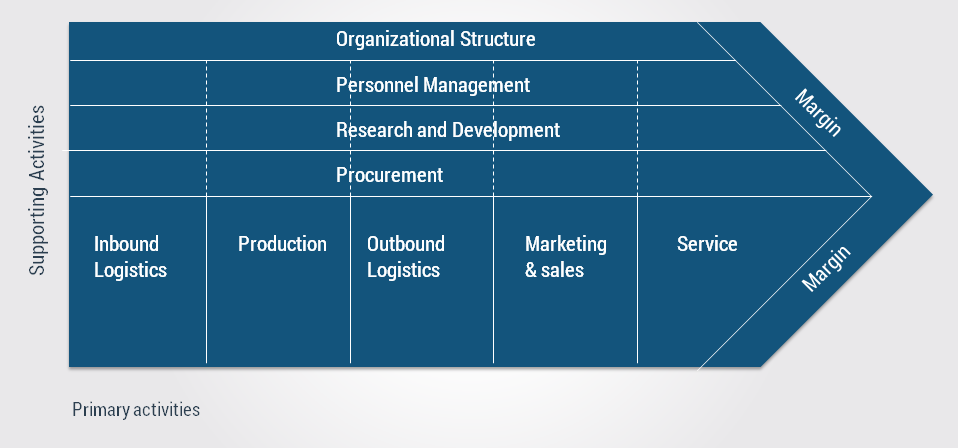
Value Chain is String of collaborating activities, that work together with a goal to satisfy market demand for specific products or services by the firm operating in a specific industry is called "value chain". Every activity in the value chain, adds value to the product or service and hence the name value chain.
Porters value chain focuses on systems that change inputs into output. Every business receives raw materials as input, add value to the raw material through various processes and sell finished products to customers. Using this primase Porter described a chain of activities that are common to all businesses and he divided them into two types of activities primary activities and support activities. Primary activities are related to physical creation, sale maintenance and support of a product or service, they consist of, Inbound logistics, Operations, Outbound logistics, marketing and sales and service.
Inbound logistics are processes related to receiving storing, disseminating incoming raw materials and distributing them as inputs for the next activity, that is transformation by adding value to the raw materials.
▸ Operations: are the activities that change inputs (raw materials) into outputs by conducting series of tasks and functions in a single or multiple process commonly called at the manufacturing process or the assembly process. here operations systems create value to the raw material as it converts the inputs to products as desired by the customers.
▸ Outbound logistics: are the activity, that deliver your product or service to the customer. It involves activities like storing/ warehousing, transporting and distributing product to the customers.
▸ Marketing and sales: Is the process of getting the customer to focus on your product over a competitor's product. Are the processes you use to persuade clients to purchase from you instead of your competitors.
▸ Service: are the activities related to after sales service. This is an important part of the overall primary activity, because the degree of customer satisfaction is very important for the success of the entire value chain.
Support activities are also known as overheads or management activities, they are procurement, Technology, Human resource management and Infrastructure.
They support the primary activities, each support activity plays a role in each primary activity, for example procurement helps to support inbound logistics by buying the right type of raw material at the right time, because you only want to process what you want to persuade your client to buy keeping in mind the competition and hence want to procure only that what you want to process.
Similarly, Infrastructure provides support to marketing and sales by providing them accounting data on every customer along with other activities,
▸ Procurement or purchasing: get the resources it needs to operate, finding vendors and negotiating prices.
▸ Human resource management: Deals with people and their skills. This activity deals with how well a company recruits, trains, motivates and rewards its employees.
▸ Technology: managing and processing information, also deals with R&D. It can also include development of technology processes for assisting primary activity.
▸ Infrastructure: is the company's support system that allows daily operations. It is also the framework of all activities that happen inside an organization like accounting, legal, administrative.
Technical developments like Cloud/mobile computing or the Internet of Things has the potential to greatly impact the way Porter's value chain can operate. Internet of things can add further value, over and above the value added by Porters generic value chain. Every activity of the chain both primary and support can be interconnected through internet as part of massive self-correcting network. The internet of things allows us to maintain and compute high level of date for longer time and with easy access by all parties concerned. For example, say that the company has something that is out of stock and a sensor on that remaining inventory connects to the internet and orders it (example could be printer cartridges). the internet of things can connect the consumer demand, usage patterns and feedback to determine what is or isn't working with their client base, create a database of information and accordingly recommend changes in procurement and process to enhance product success along with higher rate of customer satisfaction. The internet of things and value chain can work together to maintain a much better and efficient relationship.