
Project: Porter
Michael E. Porter in 1979 wrote an article for Harvard Business Review titled "How Competitive Forces Shape Strategy". Porter classified the competitive forces in to Five main competitive forces, that affect any market and all industry and helps determine an industry's weaknesses and strengths. Porter's Five Forces is a model of analysis that helps to explain why different industries can sustain different levels of profitability. The model is widely used, worldwide, to analyze the industry structure of a company as well as its corporate strategy and provide a new way to use effective strategy to manage external factors in an organizations environment, because those factors determine the profitability of an industry.
Porter's five forces model is often used as a starting point to evaluate a company's position in its industry and to assess its level of competitiveness. Though this framework is generic and applicable to any industry, it is only effective if it is used in a specific context that applies directly to the company undertaking the evaluation. An attractive market place does not mean that all companies will enjoy similar success levels. Rather, the unique selling propositions, strategies and processes will put one company over the other.
This model also helps marketers and business managers to look at the "balance of power" in a market between different types of organizations, and to analyze the attractiveness and potential profitability of an industry sector.
It's a strategic tool designed to give a global overview, rather than a detailed business analysis technique. It helps review the strengths of a market position, based on five key forces.
The Five forces are
It is these forces that determine how much competition will exist in a market and consequently the profitability and attractiveness of this market for a company. These forces, termed as the microenvironment by Porter, influence how a company serves its target market and whether it can turn a profit. Any change in one of the forces might mean that a company must re-evaluate its environment and realign its business practices and strategies.
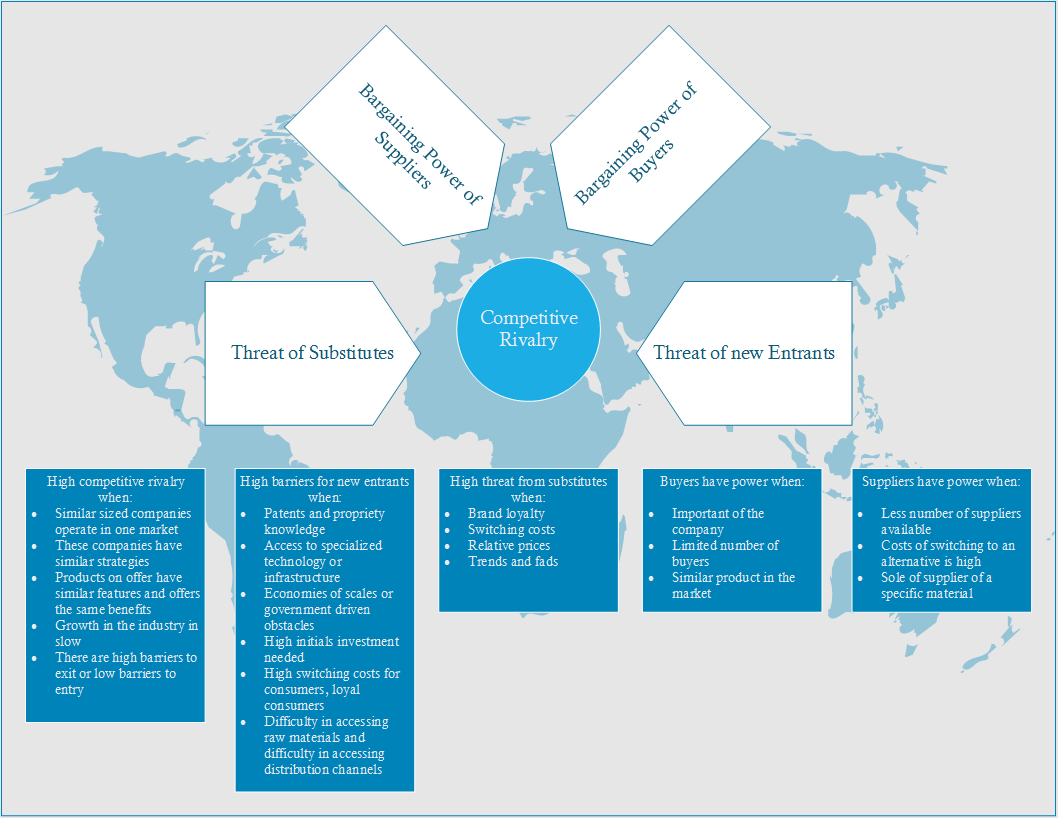
Through sound corporate strategies, a company will aim to shape these forces to its advantage to strengthen the organizations position in the industry. Within each industry, the effect of different forces will be different. Therefore, it becomes imperative to develop this model separately for every industry even if the same company is competing across different markets and industries
- Competitive Rivalry: Is the degree of rivalry between existing companies in the industry. The resulting competitive pressure will mean that prices, profits and strategy will be driven by the extent of competition.
- Bargaining Power of the Buyer: is when the buyer has the power to influence the prices of the industry. A small number of buyers may be able to exert huge pressure on the supplier, because for the supplier the buyer buys in bulk or may be the only substantial buyer of their product (and example of this being Walmart).
- Bargaining power of the Supplier: is when suppliers may be in the position to dictate terms, set prices and determine availability timelines (for example oil producing countries). A supplier may also be the only provider of a certain raw material. This may be the case in instances of Oil producing countries.
- Threat of New Entrants: Is a competitive threat from potential new entrants into the market place. The less money and time it costs for a competitor to enter a company's market and be an effective competitor, the more a company's position may be significantly weakened.
- Threat of Substitutes: A high threat of substitutes will impact a company's ability to set prices that it wants. If a substitute is priced lower or fulfills a need better than it may end up attracting consumers towards it and reduce sales for existing companies. substitute products are those that exist in another industry but may be used to fulfill the same need. For example, a sizable price difference between Honda Accord and Toyota Camry cars.
It is important for a company working on a Porter's five forces analysis to maintain an analytical frame of mind and understand the goals and expectations of analysis along with an analysis of potential beneficiaries before the process begins. During the process, it is important for a company to focus on the future rather than the past and after everything has been completed the company should identify lessons learnt and document the negatives and positives for future use.
Though this model is globally accepted, its effectiveness also depends on extreme circumstances like the impact of government on the industry or the changing nature of industries and market along with the lifecycle the industry is in. Secondly the assumption that buyers, competitors and suppliers are separate entities that never interact, never collude and never influence each other directly is not always true (for example oil producing countries)
The brief video gives one a window into the future of technology, which will be based on cloud/mobile computing because as shown there is a movement of ideas taking shape where technology with the use of internet will be used to bring every object around us alive. Where the environment will be online, and the home itself will be a computer. We are looking at a future where community of objects will work together and the information collected from each object will be stored and communicated through cloud computing at a global scale. Technology will disappear and become a part of the object. Technology will be invisible and non-intrusive and will be suited to accommodate our behavior, in fact it will become part of our surrounding nature.
The concept of "Designing the Internet of Things" will be the threat of the new entrant to the existing model of things and create a threat of substitution. For example, regular high rise buildings will be replaced with technological sound buildings where natural bio space will be used as a source of beautification and a source of energy (window panes used as solar cells, in this instance the new window panes will be a threat to existing manufacturers and also the normal glass window panes will be replaced with solar panels)The concept of internet of things will create a new type of substitutes where by the products may not be similar, however they may be substitutes for example robotic vacuum cleaners, nest learning thermostats and also online video monitoring of your personal space. We are heading towards a wired world in an invisible fashion, in small bits. In the future as the technology develops and becomes more adaptive to our needs all the small bits will be interconnected to form a larger canvas. All the existing wired technology is possible due to the availability of cloud computing, through which it is possible to store, access and explore massive data for "Designing the internet of things".